




In a sense, culture has heckled one era of stand-up comedy straight off the stage. The angry man yelling at his audience, laughing at his own racist or chauvinist jokes, has stopped being applauded. Offensive, bitter humor has largely been heckled away by a media landscape that no longer tolerates insensitivity and low-blows to marginalized or disenfranchised groups of people. Andrew Dice Clay (or even Lenny Bruce) could probably never have a successful career as a comic today.
Even when beloved and adored comics like Dave Chappelle cross a line (which is admittedly one of the functions of comedy), there’s outrage and boycotts. When comedians like Louis C.K. behave in extremely inappropriate and abusive ways, they tend to go away and remain unwelcomed by the culture at large, even after trying to make a comeback. Stand-up comedy changes with the culture.
MOVIEWEB VIDEO OF THE DAY
Dr. Heckle and Mr. Hyde
Dark Star Pictures
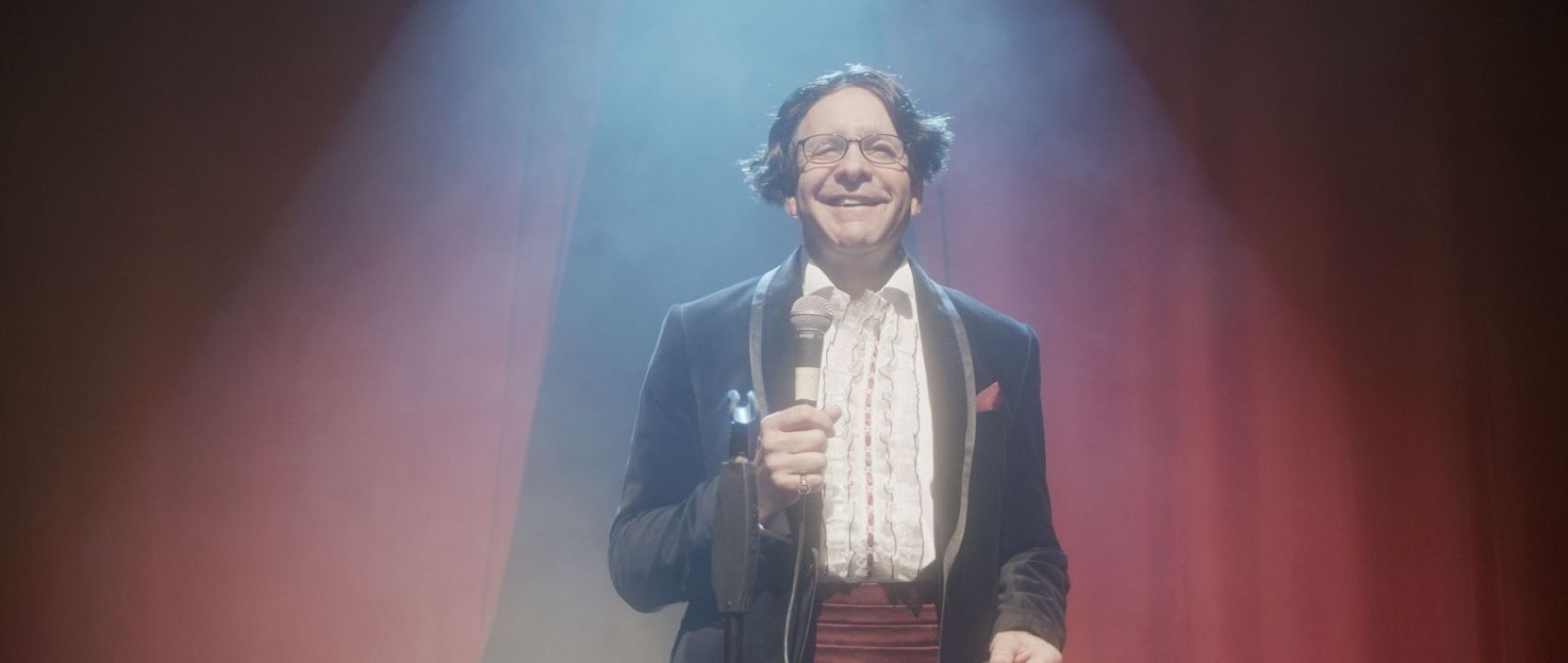
Heckle, a new film from low-budget horror director Martyn Pick (Evil Never Dies, Blood Clots), is almost a eulogy for this dying breed of comedy, and a very literal one at that. In fact, in the opening scene, offensive stand-up comic Ray Kelly (played by Steve Guttenberg) gets gunned down in his own home.
Years later, equally misanthropic comic Joe Johnson (Guy Colmes) is set to play Kelly in a biopic but is psychologically tortured and eventually hunted down by a heckler who hates him. The heckler starts in the auditorium, anonymous in the crowd and blinding lights, but then begins contacting Johnson over the phone. Perhaps it’s culture calling.
Related: Louis C.K. Heckled Over Sexual Misconduct Allegations During Secret Dave Chappelle Comedy Show
The script, from writer (and a director elsewhere) Airell Anthony Hayles, actually has a pretty great idea as its foundation. Using the framework of a traditional slasher horror movie, Hayles has filled it with possibilities and a lot of potential to update the slasher film with significant social criticism. Most of that ultimately doesn’t get realized, however; this is also the screenwriter and director of Spider Inside Her, Werewolf Santa, and Midnight Peepshow, after all.
After being heckled at a couple of stand-up performances by a heckler who gets gradually more aggressive and disturbed, Joe Johnson goes out for the Halloween season at an ’80s-themed party (tying into the possible parodies here of the slasher genre), which is actually just his entourage and other hangers-on sitting in a secluded house.
Dark Star Pictures
He brings his girlfriend Evelyn, his manager David and David’s wife, and other so-called friends, though most people exhibit a combination of fear, annoyance, and contempt for Johnson. When his phone starts to ring and the heckler is closer than he thought, nobody believes Joe or at least just thinks he’s relapsed from sobriety and is back on the bottle.
Joe is the kind of prototype of overly confident, sarcastic, and self-obsessed comedians, almost an amalgam of early-day Russell Brand with Dane Cook and Ricky Gervais. It’s hard to believe that anyone finds Joe funny, but then again, comedy is subjective, and those aforementioned comedians have become superstars, so who’s to say? What we do see of Joe’s act on-stage is patently horrible, which may indeed be intentional, as if to say: “This is the type of person we pay good money to make us laugh?”
Dark Star Pictures
It may also be intentional that Guy Colmes’ performance as Johnson is tenable at best and terrible at worst. The character is meant to be a rather despicable send-up of aggressive, cocky comics, though; combined with a late reveal which redefines aspects of the character, it almost makes sense that Colmes would play him in such an awkward, obnoxious, and unlikable way.
Steve Guttenberg Gets Dark
Steve Guttenberg, on the other hand, is disturbingly commanding as the quickly-dead Ray Kelly. He opens the film with downright menace, barking orders to his partner while he barely opens his eyes, sitting in his recliner and drinking whiskey. He is a morally repugnant, cruel, and sadistic man, who has learned how to put on a funny wig and transform his misanthropy into comedy on stage.
Dark Star Pictures
A lot of comics are actually angry in a similar way; channeling their aggression through the performative aspect of stand-up comedy is a cathartic, sometimes socially acceptable (but these days, mostly canceled) way to deal with their own bitterness.
Guttenberg appears several times in flashbacks throughout the film, each almost more vitriolic and hateful than the last. Many actors attempt to bring either some humor or some complicated psychology to a purely evil villain, hoping to create a bit of empathy or at least a dynamic, three-dimensional character. Guttenberg makes the bold choice here to go all-in on the nastiness, neither excusing one iota of Ray Kelly’s behavior nor softening his words with psychological depth.
Dark Star Pictures
Whatever humanity or compassion was once in Ray Kelly has rotted out and withered away, and the resulting husk is one of the most memorably monstrous and awful characters of recent years. It’s a drastically far cry from the charming actor’s work elsewhere in the light-hearted Police Academy, Cocoon, and Three Men and a Baby.
Several other actors have memorable dispositions (especially Louis Selwyn as Johnson’s abused manager David), and Clark Gable III (grandson of the Gone With the Wind star) shows up briefly in an odd way before his death after filming, but it’s the stand-up comedian characters who are the bloody, evil heart of the picture. As such, it’s impossible not to think of the film in relation to the contemporary art of comedy and stand-up in some way. If Heckle has a cultural argument to make, it’s that these kinds of intensely hostile and resentful male comics are a necessarily dying breed.
Horror of Heckle
As a horror film, Heckle is technically a slow burn. There isn’t really a proper slasher killing until nearly 50 minutes into its brief 80-minute runtime, and even then the film prefers to play around with tension and dark comedy a little more than with actual scares. This is probably appropriate, given the subject; comedy and horror are uniquely tied together in terms of the viscerally physical reactions they give audiences, with both jump scares and belly-laughs operating in very similar ways.
Dark Star Pictures
Heckle delivers a fairly fun (though out-of-nowhere) twist near the end which changes everything retroactively and shifts the characters’ motivations in an interesting way. It then spends a solid 10 minutes in flashbacks with Guttenberg being as malicious and hateful as possible, followed by the truth of his character’s death. This narrative device almost sucks the tension out of the film at that point, replacing suspense for exposition. Guttenberg is a terror to behold, but it’s a rather counterproductive move. The ultimate ending to the film, though, is deliciously dark when it finally comes.
Related: Scary Movies From the ’80s That Are More Funny Than Frightening
One wonders what Heckle could have been had some major producers or studios believed in it. The central conceit is pretty great, and with some provocative stunt casting of the Joe Jonson character (using an actual stand-up comedian who has faced criticism, like Louis C.K., Dave Chappelle, or Russell Brand) while retaining Steve Guttenberg’s nihilistic rage, Heckle might have been extremely fascinating and perhaps brilliant. As it stands, it’s a great showcase for Guttenberg and a quirky low-budget horror curio.
Everyone’s a Critic
Dark Star Pictures
What is the point of dismissing a film like this, though? Is a film review a kind of heckle, and a film critic a heckler? What do we really accomplish when we shoot down a film, something which takes a tremendous amount of effort, time, and skill to ever pull off, no matter how low-budget? In some ways, society has entered the era of the heckler. With social media like Twitter, and review sites like Yelp and Rotten Tomatoes, it seems like everyone has a fairly equal platform to criticize whatever they’d like.
Careers, businesses, and works of art can be ruined by simply a small handful of disgruntled individuals who think it’s their duty to criticize everything. Jobs can get lost in this process, as apps and companies rely on star ratings from frequently unpredictable customers who never take into account the fact that someone (the Uber driver, the waitress, the cook) could simply be having a bad day. The late, great chef Anthony Bourdain has some choice words for online hecklers of the Yelp variety:
There’s really no worse, or lower human being than an elite Yelper. They’re universally loathed by chefs everywhere. They are the very picture of entitled, negative energy. They’re bad for chefs, they’re bad for restaurants. You know, you open a restaurant, you struggle for a year to put together the money, you work your heart out, and then 10 minutes after opening, some miserable b—— is tweeting or Yelping, “Worst. Dinner. Ever.” […] Instagram and Twitter [are] a fully democratic bathroom wall that anyone can write on […] This is the new world we have to live in, all of us.
Who are we to yield such power? In more ways than one, society has turned into a Black Mirror episode, in which the radical democracy of the digital age has allowed everyone the freedom to attack, discredit, and destroy whomever they see fit. Maybe Heckle is a necessary movie at a time in which we’re all hecklers, to some extent.
Review: Louis C.K. New Stand Up Special Sorry
Read Next
About The Author
Matthew Mahler
(65 Articles Published)
Editor and writer for Movieweb.com. Lover of film, philosophy, and theology. Amateur human. Contact him at matthew.m@movieweb.com
You can view the original article HERE.