


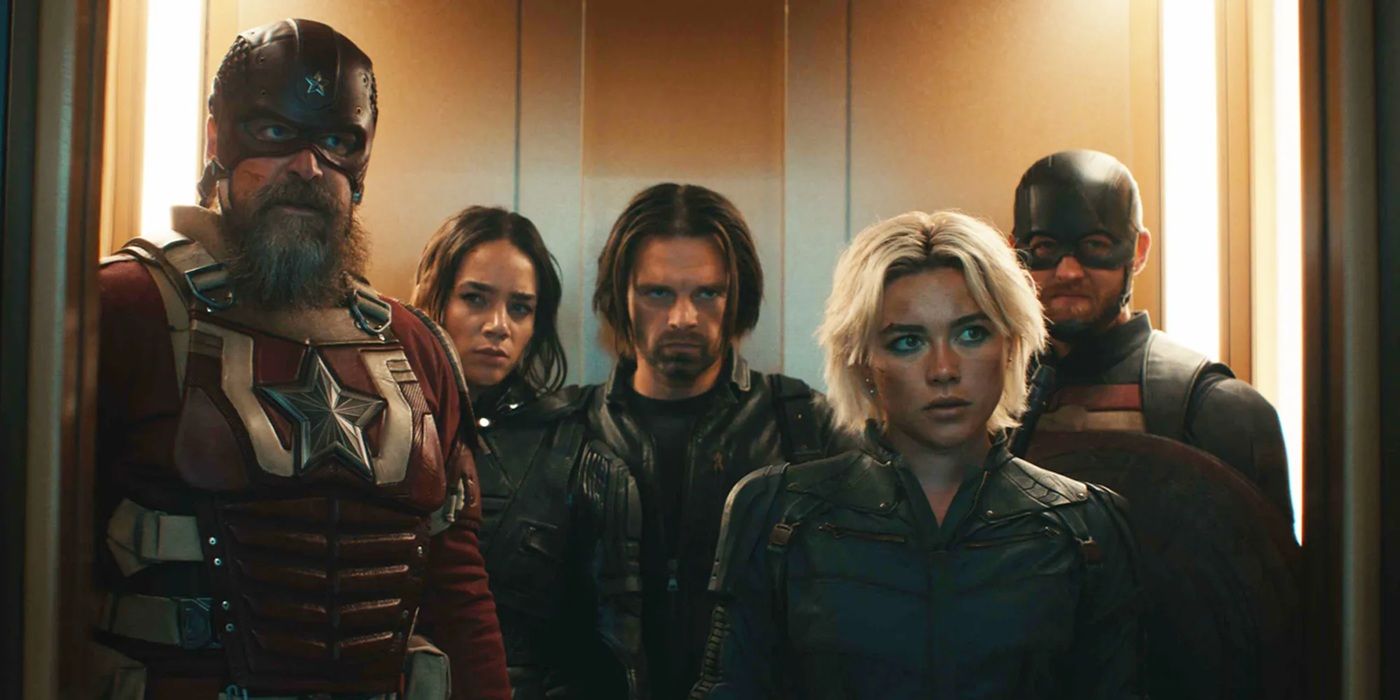
Thunderbolts* has been warmly embraced, earning high reviews from critics and fans alike. The film’s ending, which the marketing spoiled just days after the movie opened, revealed that The Thunderbolts are now The New Avengers, and it’s a game-changer. Marvel even released a new poster for Thunderbolts* with each character’s shadow being a reflection of an Avenger.
While the heroes that make up the Thunderbolts/New Avengers certainly don’t seem like your traditional Avengers roster, they are just as worthy of carrying on the team name. Marvel’s decision to bring together various supporting characters from other MCU projects that audiences considered B or C-list characters and package them together as a team feels more in line with what the Avengers were in the comics for decades. These characters might not be the A-list Marvel heroes and seemingly don’t match the gravitas that the original roster of Captain America, Iron Man, Thor, and The Hulk had. However, they have more than proven themselves worthy of being considered The New Avengers.
3
/5
Release Date
May 2, 2025
Runtime
126 Minutes
Writers
Eric Pearson, Joanna Calo
Franchise(s)
Marvel Cinematic Universe
The Avengers Were Not Always Marvel’s Big Team
Walt Disney Studios Motion Pictures
Audiences generally associate The Avengers with being Marvel’s answer to The Justice League, uniting their biggest heroes on a single team. While the concept of The Avengers began in the comics by bringing various Marvel heroes together, for most of the comics run, it tended to be the home for characters that could not support their own comics. While Captain America, Iron Man, and Thor tended to be the core three members of the team, the roster primarily consisted of characters that acted as an island of misfit toys, like Hawkeye, Carol Danvers, Vision, Scarlet Witch, Ant-Man, Wasp, and Wonder Man. If anything, the fact that every one of those characters now has their own Disney+ series or movies shows how strong the Marvel brand is. This means Jack of Hearts and Hercules aren’t off the table, right?
For nearly four decades, Marvel’s biggest teams were The X-Men and The Fantastic Four, with their biggest hero being Spider-Man. This is why all of their film rights were sold off in the first place, since they were seen as the most valuable. Starting in the 2000s, with comics like The Ultimates and The New Avengers, Marvel began to position The Avengers as a bigger deal within the Marvel Universe (certainly wasn’t a coincidence that this is also when they started Marvel Studios and began to invest in Avengers-related characters).
New Avengers made the big decision to include Wolverine and Spider-Man as part of the team, saying this was the home of Marvel’s biggest heroes. When the MCU began, the franchise was built off taking characters mainstream audiences considered second-string heroes and making them into A-list properties, and it paid off. Iron Man, Thor, Captain America, Black Widow, Hawkeye, and Hulk are more popular now than ever.
Related
Who Should Be on the Avengers Roster in ‘Doomsday’?
‘Captain America: Brave New World’ teased a new Avengers for the MCU. But which heroes should actually be on the roster in ‘Avengers: Doomsday’?
Thunderbolts*, bringing supporting characters from projects like Black Widow, The Falcon and the Winter Soldier, and Ant-Man and the Wasp, feels like what The Avengers comics were for years. Marvel doesn’t know what to do with Bucky Barnes as Sam Wilson is now Captain America, so why not put him on this Avengers-like roster?
Even though the reception to Black Widow was mixed, Marvel had a star with Florence Pugh’s Yelena Belova and realized the best place to put her was in an Avengers-like role similar to her predecessor, Natasha Romanoff. Characters like John Walker, Red Guardian, and Ghost had incomplete stories, but with no traditional sequel in sight, mashing them together into a team is a very Marvel Comics answer to solving that problem. The result is a team that, on their own, might not be able to support a project, but together form a greater whole.
The Thunderbolts Thematically Match the Overarching Theme of the MCU
Walt Disney Studios Motion Pictures
Ever since the release of Iron Man in 2008, the MCU heroes have broadly been defined by flawed characters who learn to become better people, making them worthy of being superheroes. Tony Stark was a wealthy, selfish weapons manufacturer before becoming Iron Man. Thor was a petulant prince before he was stripped of his power and learned to be humble, regaining his god-like status. Doctor Strange was an arrogant doctor before becoming the master of the Mystic Arts. Ant-Man and various Guardians of the Galaxy members were criminals before finding their paths as heroes. The idea is that it is never too late to turn one’s life around and be a better person.
The MCU has characters whose origins don’t have them overcoming deep character flaws. Steve Rogers and Carol Danvers were good moral individuals before becoming Captain America and Captain Marvel, respectively. Yet since its inception, the MCU’s core foundation has been the idea of seemingly bad people becoming better people, finding redemption and new purpose through heroic acts. This is why the Thunderbolts* fit comfortably into the franchise.
Related
‘Thunderbolts*’ Does Right by Every Character… Except One
‘Thunderbolts*’ does a great job turning the spotlight on some overlooked MCU characters, but the movie sadly lets one of them down.
The Thunderbolts / New Avengers of the MCU consist of characters with dark pasts, marked by both the trauma they’ve endured and the horrors they’ve inflicted on others. Audiences saw John Walker kill an unarmed civilian in The Falcon and the Winter Soldier in what might be one of the darkest and most visually haunting scenes in the MCU’s history. Ghost has been classified as a Marvel villain in the MCU and comics and has never been heroic. Like Natasha, Yelena has blood on her ledger. Bucky Barnes’ history as the Winter Soldier made him unlikely to be the shining symbol of hope Captain America was, and why Sam Wilson was a better fit to wield the shield. The Thunderbolts* are the heroes the audience needs right now. They speak to this specific time, like The Avengers did in 2012.
This also makes the decision to rebrand them as The New Avengers fitting. Even though The New Avengers notably added Wolverine and Spider-Man to the roster in the comics, they also added several street-level heroes, like Luke Cage, Spider-Woman, and Echo, under the guise of Ronin, while also bringing in the lesser-known and recently created character The Sentry.
Even with classic stewards like Captain America and Iron Man leading the team, it was a team that consisted of a killer like Wolverine, a wrongly convicted man with a criminal past like Luke Cage, a double agent spy in Spider-Woman, and an all-powerful god-like figure that also had a split personality in The Sentry. These were far from what audiences expected from the “Earth’s Mightiest Heroes” moniker, the same way the Thunderbolts* are. They might not seem like The Avengers, but in a weird roundabout way, that makes them the perfect new Avengers.
Do The Thunderbolts* Have a Better Dynamic?
Walt Disney Studios Motion Pictures
The Avengers and its two-part epic finale in Avengers: Infinity War and Avengers: Endgame might always be Marvel’s crowning achievement. The six characters that made up the team have certainly cemented their status as cinematic icons (they earned those big final bow credit moments in Endgame). Yet the team certainly wasn’t without its issues. One is that, despite being on a team for four films, Thor and Black Widow never share a dialogue scene. They are in scenes together, but the two never speak to one another. It took until Thor: Ragnarok to flesh out Thor’s dynamic with Bruce Banner, as the Avengers movies primarily focused on Thor and Hulk as sparring partners.
It certainly doesn’t seem fair to judge the Thunderbolts based on only one film, as characters like Ghost and The Winter Soldier get a little less to do than Yelena, John Walker, and Red Guardian. They seem to have plenty of room to grow. Ghost might be the best example, as even though she might have the least to do with the main group, there is at least a good understanding of how she feels about John Walker, Yelena, Red Guardian, and Bob. Hopefully, Avengers: Doomsday gives her and Bucky some meaningful interaction.
This clearly defined team dynamic puts the Thunderbolts in a good place heading into Avengers: Doomsday as the true heir apparent to The Avengers. Audiences not only have an attachment to this band of misfits but also know how they work together. We still don’t know who Sam Wilson’s Avengers team will consist of, and while it might feature some fan-favorites like Ant-Man, Shuri, and Shang-Chi, this opposing Avengers team dynamic won’t be as established before the big epic crossover with The Fantastic Four and the X-Men.
The Thunderbolts are a lively team of characters that fans will likely want to see more of in crossovers and sequels. It is easy to see how they can be fleshed out as a team and create exciting prospects for those who could join their roster. One look at social media shows a level of fan engagement with fan art and fan fiction pairing off various Thunderbolts members that feel close to the energy after The Avengers. This team’s place in the MCU is firmly established and will likely stick around for years to come, and we can’t wait to see what the future holds for them. Thunderbolts* is in theaters now.
You can view the original article HERE.