Writer and director Zach Cregger has just released his second feature film, Weapons, in theaters. Much like other original horror projects released this year, it has proven to be a critical and commercial success, with an impressive opening weekend box office and rave reviews. Given that this is only his sophomore feature, it’s astounding how Cregger has been able to captivate audiences and deliver two terrifyingly original films, each distinct from the other. However, both movies, Barbarian and Weapons, employ a consistent storytelling technique that elevates the story, performances, and overall scares essential to their success.
Cregger’s scripts for both of his horror films released thus far share a unique trait: they employ drastic shifts in perspective and point of view (POV) to provide audiences with new insight into the story, and in some instances, subvert expectations. The typical structure of movies maintains a singular outside perspective, allowing the audience (and camera) to act as external observers, consistently using its cast of characters to avoid confusion. However, Cregger is a writer and director who thrives in chaos, and structures his films in such a way that audiences can’t help but become invested (and anxious) with his use of unreliable narration, or throwing them into unfamiliar situations and introducing new characters late in the game.
‘Barbarian’ Set the Precedent for Zach Cregger’s Mastery Over Horror
Georgina Campbell climbing up a set of stairs in Barbarian
20th Century Studios
One of the highlights of Barbarian (aside from its mysterious marketing, which purposely withheld information) is the dramatic shift in perspective halfway through the movie, which initially confounds viewers. For the first half of the film, audiences are treated to the perspective of Georgina Campbell as Tess, a woman who rents an Airbnb that is also rented by Bill Skarsgård’s Keith at the same time, with the two developing a friendship. Once strange happenings start occurring in the house, viewers begin to piece together the direction Barbarian is taking. A typical three-act structure for a film features a midpoint that can serve as a major twist, and in the case of Barbarian, it’s the monstrous older woman living underneath the house who kills Keith.
Viewers expect to see Tess in a fight for survival for the remainder of the movie, until the cut to black transports us into the car of AJ (Justin Long), an actor in Los Angeles who has come under sexual assault allegations, which leads to the end of his career as he knows it. Suddenly, viewers are unsure of where the story is going, or why they’re following a narrative that seems disconnected from the traumatic event they have just witnessed. Cregger’s screenplay takes its time to connect the dots, which makes the dreaded return to the house Tess is trapped in feel all the more nerve-wracking.
Eventually, we learn that AJ is the owner of the property and has been renting it out, completely oblivious to what had just transpired in the house. Here, Cregger brilliantly uses a change in perspective to make the audience privy to what the new character is walking into (a technique he later employs with Weapons). By the time everything comes together in the third act, Tess and AJ’s stories collide in a resonant and emotionally powerful conclusion where Barbarian shines, not just as a terrifying movie that keeps viewers guessing, but with intense commentary on the abuse of power, the long-lasting effects of trauma, and the “MeToo” movement that is still just as relevant today.
‘Weapons’ Takes Full Advantage of Its Unique Structure To Heighten Its Mysteries and Scares
Josh Brolin in Weapons pointing his finger toward the ground.
Warner Bros. Pictures
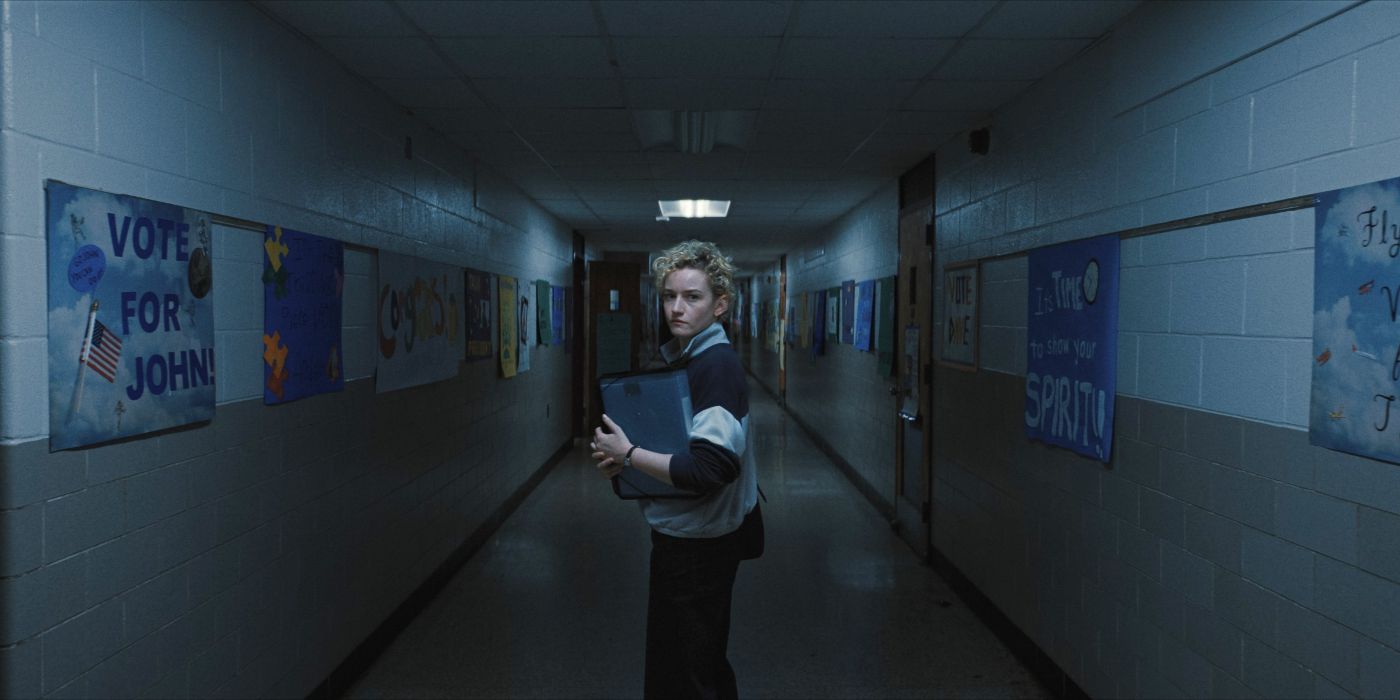
After how impactful Barbarian ended up being to the horror genre, it’s no surprise that Cregger’s next film would become a highly anticipated project. Weapons tells the story of a small town that is impacted by a mysterious traumatic event: one night at 2:17 AM, every child except one from Ms. Justine Gandy’s (Julia Garner) class ran out of their houses and disappeared. The trailers and marketing for the movie made it all feel incredibly ominous and mysterious, and thankfully, the movie lived up to expectations, in no small part thanks to Cregger’s script.
Weapons introduces the eerie mystery at its center as soon as the film starts, and then gives the perspective of each of the main characters like pieces of a puzzle. Title cards display the characters’ names, signaling perspective shifts and preparing viewers for the narrative change. The movie starts with Justine, showing her emotional turmoil as the community seemingly blames her just because it was her class that all the missing children are from. The nonlinear narrative is done to a much more extreme extent than Barbarian, but it still works just as effectively.
Moreover, the point of view shifts just as things begin to get horrific, creepy, or intense, which can make viewers anxious and invested in seeing what happens next. For example, a lock of Justine’s hair is cut in her sleep right before the movie shifts perspective to Archer (Josh Brolin), the father of one of the missing children. Everybody, from a local cop, Paul (Alden Ehrenreich), to the principal of the school, Marcus (Benedict Wong), and even a homeless drug addict, James (Austin Abrams), get a chapter dedicated to them in the film, with some overlap happening in the stories that can either give context to something previously shown or lead to even more unanswered questions. Eventually, all the characters’ arcs intersect and are given a conclusion from Alex’s perspective, the only student who didn’t disappear.
The Ending of ‘Weapons’ Feels Like the Missing Piece of a Twisted Puzzle
A still of a creepy kid smiling with paint on his face from the new trailer for Zach Cregger’s horror film ‘Weapons’.
Warner Bros.
Much like when AJ’s story intersects with Tess’s in Barbarian, Alex serves as the missing puzzle piece that completes the picture that is Weapons. Cregger’s script juggles so many different characters so effectively, using each to convey a distinct way grief can be processed, while also incorporating jump scares and building tension in a way that only frequent shifts in perspective can achieve. There’s a certain kind of intrigue in the way the Weapons director employs alternate angles of the same scenario, which gives him mastery over the horror genre. The result is a satisfying film like Weapons, which utilizes its ensemble to its fullest extent.
While Cregger has already said that his next planned film, Resident Evil, will be unlike his last two projects, fans of the director can at least take heart that the filmmaker already has a solid grasp on the horror genre. With Cregger’s effective use of alternating points of view, Weapons delivers intense thrills and suspense like no other horror movie in recent memory. Perspective is an incredibly important aspect of the horror genre, and the filmmaker’s expert handling of it proves that he has a solid grasp on what it takes to make an audience invested. Weapons is in theaters now.
Release Date
August 8, 2025
Runtime
128 minutes
Producers
Roy Lee, Miri Yoon, J.D. Lifshitz
You can view the original article HERE.