114
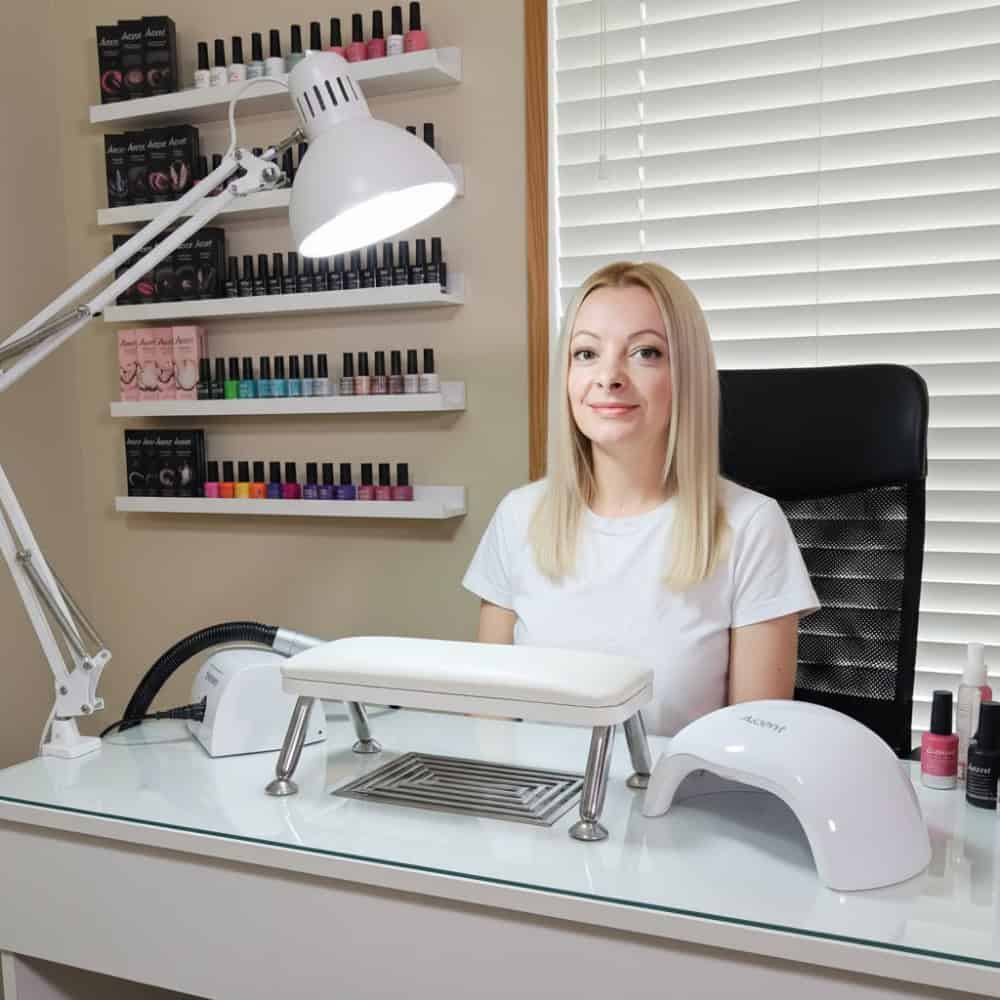
For decades the French manicure was synonymous with frozen elegance. But in 2024 this most conservative of designs has transformed into a testing ground for high-tech experimentation with shape, color, and materials. Ludmila Dyshlyuk — whose expertise in this space is backed by a win at the World Beauty Championship (WBC IV) in the French manicure category and the title of Nail Artist of the Year at the IBA XV awards — walks us through how technicians are using light, shadow, and textural contrast to make the French one of the year’s most exciting trends.
Micro-French and the Clean Girl Aesthetic
The dominant story of 2024 has been extreme minimalism, embodied in the micro-French. Unlike a traditional French manicure — where the width of the free edge can vary considerably — micro-French operates in fractions of a millimeter.
“A line literally the width of a hair, applied with the finest liner, lets the technician create a graphic accent that doesn’t cover the nail plate — it simply traces its edge,” explains Dyshlyuk. “This works beautifully even on short shapes like the soft square, where a wider line would visually cut the nail and make it look shorter.”
Micro-French fits naturally within the Clean Girl aesthetic, which prizes an effortlessly natural look: the hairline stripe mimics the healthy sheen of a natural free edge rather than reading as a painted decorative element.
“On the technical side, micro-French has been enabled by materials like Builder in a Bottle — BIAB — which allow you to build a coating that’s strong but visually weightless,” Dyshlyuk adds. “BIAB is a category of hybrid nail materials with high viscosity and controlled self-leveling properties.”
In the courses Dyshlyuk has developed for her Studio Fancy center in Chișinău, she teaches fellow professionals how to use contemporary materials to build proper nail architecture and reinforce the free edge while keeping coating thickness to a minimum.
Chrome Texture and Industrial Edge
The global obsession with pearlescent shine has found its way into French manicure through Glazed Donut Nails — what fashion publications are calling the evolution of the Hailey Bieber look.
“It’s a modification of the classic design where, at the final stage, a pearl or opal powder is applied over the finished French,” says Dyshlyuk. “Technically, it involves pressing a fine-particle pigment into a cured, tacky-layer-free top coat, which produces a soft light-refracting effect across the entire nail surface.”
What makes the technique distinctive is how it changes the optical properties of the coating: the semi-transparent layer of powder visually softens the boundary between the free edge and the base without fully obscuring either.
“Another interesting variation is the futuristic mirror-chrome free edge,” she continues. “Unlike classic techniques that aim to imitate natural tones, this reads more like a high-tech accessory than a traditional manicure.”
The look appeals to those who find classic French too conservative but love its architectural quality. Chrome performs best on well-defined shapes — square and sharp almond in particular.
From Pine Green to Butter Yellow
The color palette of the French manicure has expanded dramatically this year, with rich, complex pigments stepping in for traditional white. Leading the charge are deep, near-black shades — noir cherry and dark chocolate — first seen on the FW24 runways in New York and Paris.
“When working with colors like these, technicians use extremely high-density pigments to pull a clean line in a single pass,” Dyshlyuk explains. “That keeps the tip zone as thin and natural as possible, avoiding the thick, ‘stuffed’ look at the edge. The dark tip ends up functioning as a graphic frame that anchors the nail’s entire architecture and makes the shape look longer and more refined.”
An even more recent development is the arrival of pine, khaki, and olive as leading French manicure shades. In autumn roundups from professional publications, pine — or forest green — has been named the key luxury pigment of the season.
On the lighter end of the unconventional spectrum, butter yellow has claimed the top spot. The color has particular optical qualities: it’s less assertive than a classic neon but delivers enough brightness to make the free edge read as a genuine accent.
“It’s often used in micro-French or in gradient sequences where the intensity shifts from finger to finger, building a complex rhythmic effect across the hand,” Dyshlyuk notes.
Those gradients along the free edge are achieved with a flat brush: pigments are blended directly on the bristles, then pressed evenly into the smile line. Getting a smooth color transition within such a narrow band is nearly impossible with standard tools. The technique demands precise control over both pressure and brush angle — which is why Dyshlyuk’s curriculum dedicates a dedicated course to it.
Geometric Deconstruction and Double Lines
The deconstruction of the traditional smile line has made double and floating French designs genuinely popular. Rather than a single solid stripe, technicians draw two parallel fine lines — or trace only the outline of the free edge, leaving the interior unfilled. That approach is known as negative space.
“The unpainted or semi-transparent area becomes part of the design itself, not just a background. The result looks lighter, thinner, and more contemporary than a solid white edge,” says Dyshlyuk.
classic soft curve, two straight lines converge at a sharp angle, creating a pronounced vertical. It’s a dynamic — aggressive, even — take on the French, about as far from the original’s softness as the format can go.
Art French and Micro-Realism: The Free Edge as Canvas
Classic French has stopped being monochrome. Defined boundaries have given way to botanical French and micro-realism, where the free edge becomes the surface for miniature painting.
“It’s a return to complex hand-painted work — but at a completely different scale,” observes Dyshlyuk. “Where decorative elements once covered the entire nail, they now integrate delicately into the French zone.”
Think finely rendered sprigs of lavender or eucalyptus, gossamer-thin wild grasses, or miniature dragonflies and bees.
Executing these designs requires proficiency in Chinese brush painting technique — which is why Dyshlyuk’s course lineup includes exactly that. She teaches the art of calligraphic brushwork with a flat brush, enabling nail technicians to capture the play of shadow on a petal or the texture of a leaf within a space just a few millimeters wide.
Volumetric Effects and 3D Sculpting
This year, 3D elements have been making a serious push into the smile zone. Dua Lipa’s 3D gold French manicure — where tiny gold beads replaced a painted line — is a perfect example: a trend that swaps a flat colored stripe for a dimensional element, moving French firmly into the territory of micro-sculpture.
“The technical backbone of this trend is the builder gels we’ve already mentioned — they combine the strength of acrylic with the flexibility of gel, making them ideal for structural 3D accents. These formulations let you sculpt a molten metal effect along the free edge, mimic the texture of gemstones, or create hyperrealistic droplets,” says Dyshlyuk.
The focus shifts here from color pigment to the physics of how a surface interacts with light. Dimensional elements produce complex plays of shadow and refraction, giving the design a dynamism that painted French simply can’t achieve.
In her advanced art design courses, Dyshlyuk teaches how to integrate sculpting and decoration so that 3D details aren’t just embellishments — they’re a logical extension of the nail’s underlying architecture. That kind of design turns a manicure into wearable art, where the familiar smile line is simply the foundation for something far more sculptural.
Presented by DN NEWS DESK
You can view the original article HERE.