





378
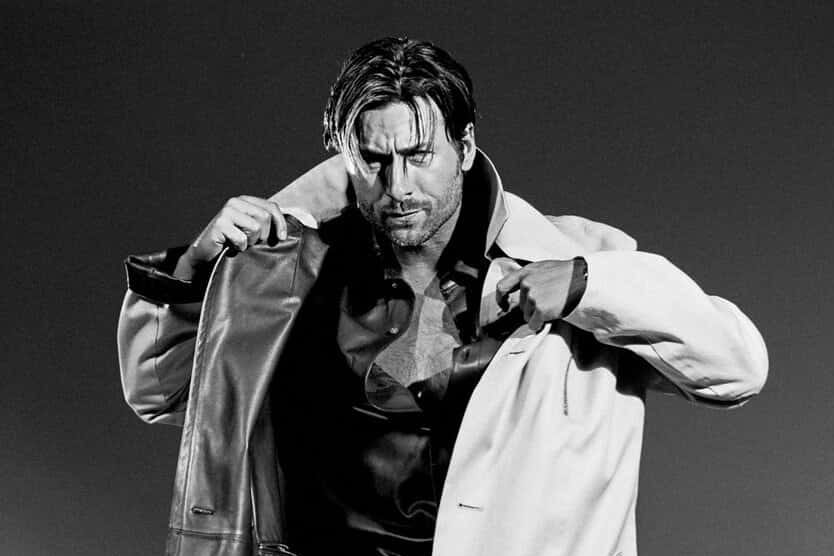
Glen Powell is everywhere these days, including the latest cover of Esquire, where he’s promoting of slew of new movies, including one that nearly cost him his hand and left him “broken, physically and emotionally.”
Here are some of our favorite excerpts from Madison Vain’s expansive profile of Hollywood’s reigning action king.
Glen Powell (Esquire/Billy Kidd)
Powell on his relationship with Landman actress Michelle Randolph:
Powell and Randolph first caught the attention of gossip hounds in the fall of 2025; it’s a recipe that Powell says just works. “Life is fast for both of us,” he says, “and we have the same values. She loves her family. I love my family. And we both care about work a lot. We both like to show up for our partners. And yet we also understand the balance of it all.” Hollywood is not exactly known for launching healthy, long-lasting relationships. The schedules, the inherent competition, the way social media lets the public sneak between two people with unsolicited opinions. It’s all a mindf*ck. For Powell, his relationship with Randolph is the antidote. “There’s something so lovely,” he says, “about someone rooting for you. Someone who wants you to win in all the ways that are good for you as a human. Not just professionally but in all the ways that are good for your soul.”
Powell on Top Gun 3 and Tom Cruise:
“I probably know as much as you do,” he says. This is, of course, bullsh*t. Powell speaks to Tom Cruise regularly; Cruise has become a mentor and a safe space for him in this industry. Cruise tends, Powell says, to have a sixth sense and gives him a call when he knows he needs it most. They spoke last week by phone and recently had dinner in London. So, like I said, bullsh*t. Powell laughs. “I know general brushstrokes of a story,” he admits. “I haven’t read anything.” He’s spoken to both “TC and Jerry”—as in Bruckheimer—but, he cautions, “Tom’s not going to do it unless he thinks it can beat Maverick.” A tall order indeed. “Hopefully I’m not the age of Maverick in Maverick by the time I make it.”
Glen Powell (Esquire/Billy Kidd)
Powell on initially saying “no” to the part of Hangman in Top Gun: Maverick:
The thing is, Tom Cruise doesn’t really like hearing that word, and after a frank conversation with Powell in a studio conference room several months later, Cruise promised he’d elevate the character to something worth doing. The ask was simple: Trust me. Powell agreed. Filming took a year, and then the edit took another. By the time the film was ready, Covid was raging and theaters were closed. The studio told Cruise to release it for at-home viewing, and now it was Cruise’s turn to decline. He wanted to wait. That delay tested every individual strand of Powell’s patience. “You’re just waiting for your life to change,” he explains. It did. Jerry Bruckheimer, producer of Maverick but also so many other movies you love, like Armageddon, Bad Boys, and Pirates of the Caribbean, says he had fun ribbing Powell after the film’s release: “I said to him, ‘How would you feel right now if you had turned down the part?’”
Powell on injuries during The Running Man shoot:
Powell ruptured a tendon in his hand, except he didn’t know he ruptured a tendon and was instead hyperfocused on not delaying production. “Running Man had a release date, and I had the J. J. Abrams movie on deck,” he says by way of explanation. But the pain worsened and his hand began to swell and swell. Soon Powell found himself in a Bulgarian emergency room, where he learned not only that the tissue had been severed completely but also that he had a septic infection. “This is the real deal,” the doctors cautioned. Powell needed surgery right away, and before he was put under, the attendings gave him a warning: “You could wake up without a hand.” Powell’s medical team recommended he keep the injury dry, warm, and at rest. Instead, he and the filmmakers wrote the need for bandages into the script, and Powell shot the very next day, scaling an apartment building in, as he recalls, “negative 10-degree weather with one arm.” He had nothing but a bath towel slung around his waist. “I left that movie broken, physically and emotionally,” Powell admits.
Glen Powell (Esquire/Billy Kidd)
Powell on weak ticket sales for The Running Man and How to Make a Killing:
Expectations for The Running Man were sky-high, but ticket sales were weak. More hard lessons. “They let go of an entire marketing department a month before our movie came out in the middle of a merger,” says Powell, referencing behind-the-scenes chaos at Paramount, the film’s studio. And then his immediate follow-up, the 2026 A24 thriller How to Make a Killing, came and went with minimal fanfare. “There were a lot of issues with that,” Powell says. “There just was not enough time to do it properly. I look back on that one as an example of going, You know what, there’s no rush.” Except Powell’s slate was full, and there was a rush. It doesn’t sit right.
Glen Powell (Esquire/Billy Kidd)
Powell on politics:
“Over time,” he says, “I realized that politics divide people. People trying to prove their point— for me, it’s the worst version of a conversation. I genuinely do not like the discourse. It’s not as healthy as it once was.” Engaging, then, for him is “not presently possible,” he says. “I applaud people for jumping into those things and fighting for what they believe in. If I were a political person, I would be talking about it. For me, my calling is elsewhere.”
Powell on whether the upcoming Ron Howard movie about firefighters is Backdraft 2:
There is also the untitled Ron Howard movie about firefighters that is—well, let me just ask him. Is that Backdraft 2? “It’s not,” he says. “It has no connection to that movie. It just happens to have fire involved.” He’s excited about this one because he wants to shoot fire like Maverick shot fighter pilots: for real. Plus, he adds, “Who hates a firefighter?”
Glen Powell (Esquire/Billy Kidd)
Powell on when both his parents were diagnosed with cancer:
When Powell was twenty-four, both of his parents were diagnosed with cancer. Any cancer is bad, but his mom’s was really bad. Powell grows emotional speaking about the event some thirteen years later. “I remember exactly where I was getting that news,” he says. “And how I felt, and how she felt at that time.” The memory pulls him away for a moment. His eyes cloud over and he stares off into the distance. He swallows the feelings that bottle up in his throat, not without difficulty. The Powells didn’t have a ton of money. And while Powell is grateful for the lessons that imparted, mainly that you can’t have everything and your choices between what is available will define you, it also meant that they couldn’t afford the best care. Powell, a dead-broke wannabe actor, couldn’t do much. Still, “I was like a telemarketer,” Powell recalls, “calling everyone I knew who could have donated to a hospital ever.” He felt useless. “I was poor, and I had nothing going on. I had no resources to help my mom. And I know people who, because they couldn’t get good care, their parents died.” Powell’s parents returned to good health. But Powell knew he never wanted to be in that position ever again. That he would never be in that position again. “In terms of financial motivation, that was it,” he says. A few years ago, his parents weren’t doing great again—his dad had a health episode that Powell describes as “stroke-ish.” Powell spared no expense. Concierge doctors. Treatment plans. Whatever they needed. They returned to even keel. “I can’t tell you the feeling I had afterward,” Powell says. Relief, euphoria, accomplishment.
Esquire’s October/November issue is available October 13 wherever magazines are sold.
You can view the original article HERE.