
:quality(85):upscale()/2026/10/07/802/n/1922283/657027816ac68c289f83b0.18090778_.png "What the Jaguar Type 01 Premiere in NYC Was Like")







164
Fresh from Paris Fashion Week, and still basking in the afterglow of the shows, we found ourselves ready for a change of scenery—and set off for Munich, where we discovered a treasure. Munich is Germany’s great intersection of old-world wealth and new-world sophistication: haute bourgeoisie elegance, monumental museums, fabulous fashion, and aspirational automobiles. With Condé Nast and BMW headquartered here, designer flagships lining [the avenue] Maximilianstrasse, and an extraordinary concentration of art, architecture and gastronomy, the city has cultivated a rather impeccable sense of taste. We spent 48 hours scoping out the best addresses — hotels, restaurants, museums, boutiques and gardens — so you don’t have to. Consider this our very condensed field report.
The Mandarin Oriental, Munich occupies a building with a rather fabulous past. Constructed between 1875 and 1880 during the reign of King Ludwig II, the building was originally known as the Central-Säle, or Central Halls, a grand entertainment complex of ballrooms. Fast forward nearly 150 years and the building has become one of Munich’s most elegant addresses.
We were ensconced in the Tower Suite, and “suite” hardly seems sufficient. This grand one-bedroom features curved windows framed by six-meter silk curtains, a dining room for six, a bedroom with walk-in wardrobe and a spacious bathroom. The interiors strike that particularly difficult balance between historic Munich and contemporary Orientalism, with custom furnishings, delicate artifacts, Munich-based artwork and natural materials. The bathroom, with its deep soaking tub, walk-in shower and twin vanity, feels more sanctuary than bathroom.
The circular sitting room is the pièce de résistance. There is something wonderfully theatrical about sitting in the middle of a room that curves around you. It feels less like a hotel suite and more like your own private stage set. Bravo!
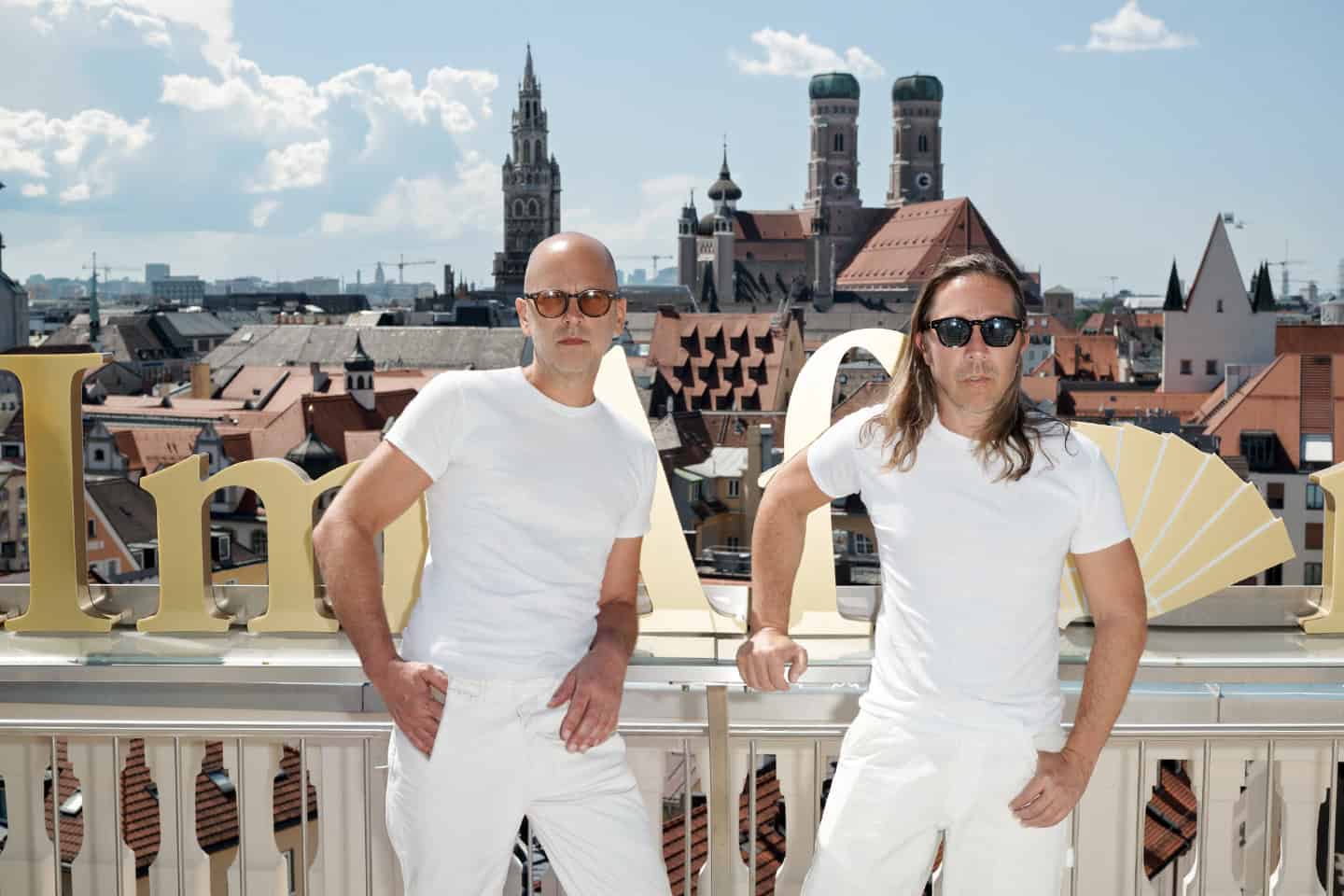
The rooftop at the Mandarin Oriental is, quite simply, where Munich goes to see and be seen. There is a pool, sweeping views across the rooftops of the Altstadt and the Munich Sushi Club, where Japanese cuisine, cocktails and the inevitable bottle of Veuve Clicquot seem to flow with equal enthusiasm. The atmosphere is part Riviera, part Alpine resort, part European fashion weekend — and entirely Munich. Go at sunset. Dress accordingly. The city turns gold, the rooftops begin to glow and suddenly you understand why everyone seems to have found their way upstairs.
Back inside, the grand corridors and marble staircases proved too seductive to merely walk through. They inspired an impromptu fashion shoot — because apparently even a staircase can become a location when you’re incapable of passing a good one without stopping.
Last but not least is ORY. An elegant indoor-outdoor cocktail bar with the sort of lighting that makes everyone look slightly more alluring, ORY is anchored by a horseshoe-shaped bar and wrapped in dark green, gold, brass, wood and red velvet. Its outdoor terrace extends the mood into the open air, an elegant urban perch for watching Munich drift by over champagne and cocktails. Here, the well-heeled come and go, champagne is poured and cocktails are mixed with considerable seriousness.
If you want the Munich of the movies, the Munich of grand opera houses, elegant interiors and waiters who know exactly what they are doing, head to Spatenhaus an der Oper. The history of the Spaten brewery reaches back to 1397, and the restaurant sits directly opposite the Nationaltheater, overlooking the magnificent Max-Joseph-Platz. Ask for a table upstairs. The dining room is richly traditional, with ornate detailing, classical artwork and glittering chandeliers, and sweeping views over the square. It is wonderfully old-fashioned in the best possible way.
And the food follows suit. This is Bavarian comfort food elevated by sheer conviction: sausages, potato salad, roast meats, schnitzel, dumplings and all the hearty things one promises oneself one will never eat again — until they arrive at the table. The Wiener Schnitzel, naturally, is one of the signatures, alongside roast duck, Schweinsbraten, Tafelspitz and an assortment of Würstl. And, naturally, there is beer. This is Munich, after all.
DIE MODERNE
For the opposite experience, head to Schumann’s, Munich’s most fashionable restaurant and one of the city’s most notoriously difficult reservations. Perched on Odeonsplatz in the shadow of the Residenz Museum and at the edge of the Hofgarten, Schumann’s is less restaurant than institution — a sophisticated Munich salon disguised as a bar.
The interior is pure mid-century European cool: dark wood paneling, red leather banquettes, immaculate lighting and the particular atmosphere of a room that has seen generations of interesting people come and go. This is where Munich’s fashion crowd, creatives, old money and visiting celebrities converge, making a table here feel less like a reservation than an invitation. The cuisine is deliberately unfussy: pasta, risotto, a good steak and a fresh salad. Nothing is trying too hard. The drinks, however, are another matter.
Schumann’s is one of those rare places where the cocktail is treated as a cultural object rather than merely something to drink. The white-jacketed service, polished bar and beautiful setting overlooking the Hofgarten make it one of the city’s most enduring fashionable addresses. During the day, lunch can spill out toward the avenue and garden. Later, the room changes character. And after midnight, it becomes what it was always meant to be: a bar.
There are parks, and then there is the Englischer Garten. Munich’s most iconic green space is essentially Central Park’s chic German aunt — impossibly expansive, beautifully maintained and filled with people who seem to know exactly how to enjoy a Sunday.
Created in the late eighteenth century by American-born physicist and inventor Benjamin Thompson, the Englischer Garten stretches across nearly 1,000 acres and is woven into the life of the city. The Eisbach river provides one of Munich’s great summer spectacles — and one of its most refreshing places to cool off. Then there are the Biergartens, the Chinese Pagoda, the musicians, the roasted chicken, the sausages, the salads and, naturally, the beer. We spent an afternoon wandering beneath the trees, watching Munich’s elegant population migrate toward the sunshine. No visit to Munich is complete without it, and no Sunday is improved by having anywhere else to be.
Every great city needs a great food emporium. Munich has Dallmayr. With roots dating back to around 1700, Dallmayr has evolved into one of Europe’s great delicatessens — part gourmet department store, part culinary museum, part theatre of temptation.
The original Stammhaus is a sensory assault in the most luxurious possible sense. There are chocolates, pralines, coffee, tea, caviar, oysters, cheeses, meats, breads, pastries and enough exotic delicacies to make you question whether you have accidentally wandered into a royal pantry. And historically, you almost have. Dallmayr became a purveyor to the Bavarian royal court around 1900 and eventually served fourteen other European royal houses in addition to the German imperial court.
Today, the institution remains gloriously devoted to the pleasure of food. The windows alone are worth the visit. We went in for a look. We left with provisions!
HOFBRÄUHAUS-KUNSTMÜHLE
For something considerably more humble — and perhaps even more dangerous — make a pilgrimage to the Hofbräuhaus-Kunstmühle. Since 1703, this family business has been producing flour and baking ingredients in the heart of Munich. What attracted us, however, was not the flour. It was the bread, the pretzels, the sourdough rolls and the seasonal pastries that seem to have been designed specifically to sabotage any attempt at self-control. The old-school shop is a feast for both the palate and the eye, filled with the kind of honest, beautifully made baked goods that make you wonder why anyone ever invented packaged bread. Buy something. Eat it immediately. Regret nothing.
LEGACY LIBATIONS
Pusser’s, is the legendary American cocktail bar tucked into the Altstadt, and the Munich sister to Paris’s Harry’s New York Bar. Since 1974, it has been the sort of place where the owner still decides who comes through the red velvet rope. Inside, the crowd is a wonderfully improbable mix of aristocrats, models, old Munich regulars and bohemian passersby. The atmosphere is gloriously old-fashioned — dark wood, brass, quiet jazz and the faint sense that something interesting might happen after midnight. Order the Pusser’s Painkiller, the house signature, and let it do exactly what its name promises: for a few hours, all earthly worries seem rather beside the point.
Munich has no shortage of museums, but if we had to choose only one address for the culturally curious, it would be the Pinakothek der Moderne. Actually, calling it a museum is selling it rather short. It has four museums under one roof: art, graphics, architecture and design.
We spent the better part of a day there and still only managed two of them.
The Sammlung Moderne Kunst alone is enormous, with more than 20,000 works spanning painting, sculpture, photography and new media. The collection moves through the great avant-garde movements of the twentieth century and into contemporary art, with works by artists including Pablo Picasso, Max Beckmann, Paul Klee, Andy Warhol and Salvador Dalí.
The scale is almost overwhelming. There are galleries devoted to entire movements, rooms organized around individual artists and moments where the architecture becomes as compelling as the art inside it. For two people who spend their lives thinking about image, proportion, color, material and form, it was essentially an extended day of professional temptation.
The Design Museum – Die Neue Sammlung. – is a design junkie’s dream archive, containing roughly 120,000 objects across more than twenty areas of design. Automobiles, furniture, industrial objects, household objects, electronics and graphic design — from Bauhaus to contemporary design, it is a history of how the objects surrounding us have shaped the way we live.
And yes, there is Nintendo. But also Mercedes-Benz, which takes us from gaming to automotive design in one elegant leap.
Tucked into a loft on Falkenturmstrasse, EDEM Chambre Privée is the creation of Edem Adobaya, a Paris bred fashion insider whose career eventually took him into more than a decade of buying and fashion direction for Giorgio Armani’s German business.
In 2019, he opened EDEM Chambre Privée in the heart of Munich. Calling it a boutique feels almost misleading. It is a salon. A private world. A place where fashion is less about commerce and more about conversation, discovery and the construction of a wardrobe with a point of view. And you feel that immediately. The setting is intimate and decidedly residential, more artist’s loft than retail environment. The clothes are presented as part of a larger narrative rather than arranged for maximum inventory exposure.
Edem is a curator, a connector, a pied piper of fashion. His clientele is borderless and the relationships he has created extend well beyond the transaction. He is building a community around fashion, art and the pleasure of discovering something that feels personal. That is what makes EDEM interesting. He isn’t simply selling clothes. He is building wardrobes as narratives — collections of objects that become part of the story of the person wearing them.
Edem is preparing to open a new ground-floor boutique that will bring his vision to a broader audience. Downstairs will be the grand introduction — almost like the check-in at a five-star hotel — where iconic pieces and Edem’s highly edited point of view will welcome a larger public. Upstairs will remain the penthouse, the private salon, the place for the initiated. The distinction feels very Edem. And very Munich. Because perhaps that is what we discovered during our 48 hours here. Munich does not need to announce its luxury. It simply assumes you will recognize it.
Bis bald, München.
— Brian & Claude
Follow Wolk Morais on Instagram!
Photos by Quentin Krüger
You can view the original article HERE.